All people by nature desire to know.
Πάντες ἄνθρωποι τοῦ εἰδέναι ὀρέγονται φύσει.

Aristotle, Metaphysics 980a
Welcome to the Centre for Classical Studies
Paulo Farmhouse Alberto
Director
Fotini Hadjittofi
Deputy Director
Carlos Guardado da Silva
Deputy Director
History
The Centre for Classical Studies was founded by Francisco Rebelo Gonçalves in 1966 within the framework of the Portuguese Institute for High Culture. Gonçalves became the first Director of the Centre and assumed the responsibilities of editing and managing the scholarly journal Euphrosyne. The Centre was originally based in the Department of Classical Studies (DEC) in the Faculty of Arts and Humanities of the University of Lisbon.
When Gonçalves retired, Maria Helena Ureña Prieto succeeded him in the direction of the Centre and Euphrosyne. After the creation of the National Institute of Scientific Research, the CEC was directed by a commission comprising five members presided over by José António Segurado e Campos.
In 1994, the CEC was restructured, becoming independent of the DEC and integrated into the University of Lisbon. In that same year, Aires A. Nascimento, the Director of Euphrosyne since 1985, assumed the role of Director of the Centre for Classical Studies, with Vítor Jabouille as his Deputy. He then consolidated the structure of the CEC into five main areas: Greek, Classical Latin, Medieval Latin, Renaissance Latin, and Instrumenta. With an unparalleled work capacity, he led the CEC until his retirement in 2008. Afterward, Arnaldo do Espírito Santo served as Director until 2010 when Maria Cristina de Castro-Maia de Sousa Pimentel took the reins. She headed the Centre until 2017, when Rodrigo Furtado was elected Director. His term concluded in 2025 with the election of Paulo Farmhouse Alberto, the current Director.
Contacts
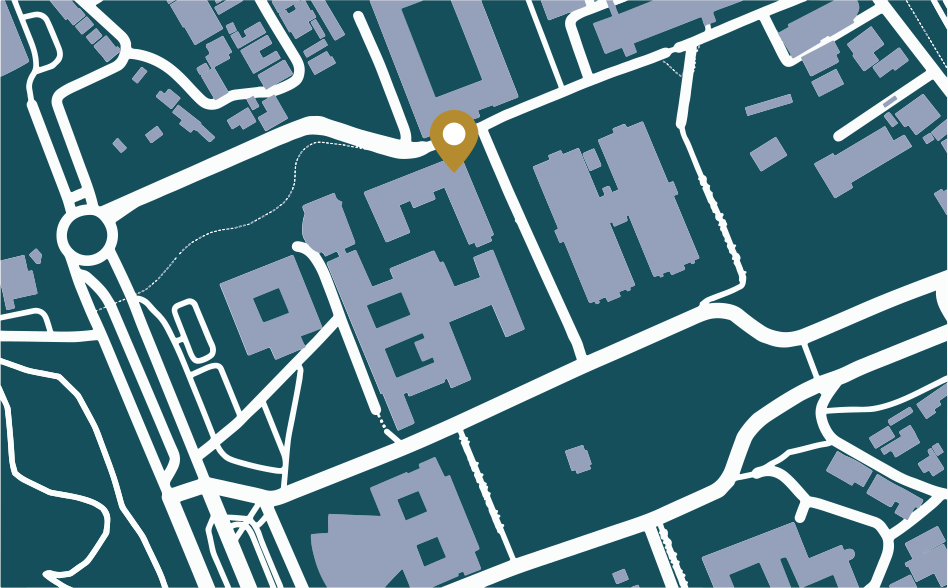
Faculdade de Letras da Universidade de Lisboa
Alameda da Universidade
1600-214 Lisboa
Portugal
Telephone: (351) 217 920 005
Fax: (351) 217 920 080
e-mail: centro.classicos@letras.ulisboa.pt
Opening times:
10:00-12:00, 14:00-16:00 (working days)